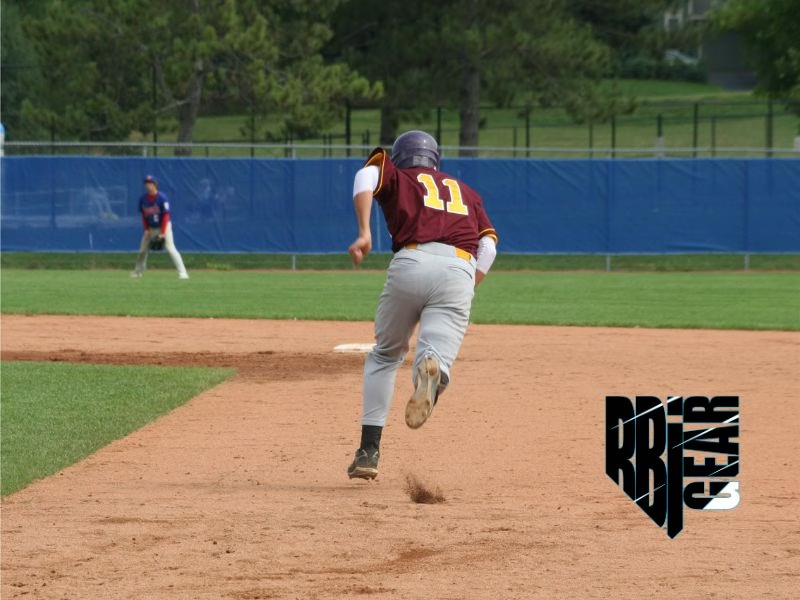
How to Run the Bases on a Pop Fly
Pop flies can be tricky for baserunners. Whether you’re on first, second, or third, your decisions depend on the number of outs, the depth of the ball, and the fielder’s actions. Here’s how to make smart, aggressive—but safe—choices when the ball goes up.
With Less Than Two Outs: Go Halfway (on Routine and Deep Fly Balls)
When there are fewer than two outs and the ball is hit deep into the outfield, runners should go halfway between their current base and the next one.
- If it drops: You can advance easily and safely.
- If it’s caught: You have enough time to retreat and avoid being doubled off.
The key is judging depth. A deep fly that looks like trouble for the outfielders allows a runner to get farther off the bag. A routine fly should keep you closer to the base, ready to hustle back. And keep in mind, the applies for fair and foul balls.
Shallow Fly Balls: Stay Short of Halfway and Read the Outfielders
On shallow fly balls—especially those hit to short outfield or in-between territory—runners should play it safer. The throws are shorter, and one out is always better than two.
- Stay a little less than halfway between bases.
- Watch the outfielders’ routes and body language.
If the outfielder is charging in, you should be leaning back toward your base, ready to return. If they’re sprinting back or turning sideways, prepare to advance. The goal is to never get caught too far from safety if the ball is caught or trapped.
On Third Base: Tag or Read the Throw
Running from third requires special awareness because the play often determines whether a run scores or not.
- Deep Fly Ball: Get on the bag and prepare to tag up. You can leave as soon as the ball is touched, not necessarily caught. This is a critical rule many players—and even umpires—miss.
- If the outfielder bobbles the ball but still catches it, you can legally tag and go as soon as the glove first touches the ball.
- Shallow Fly Ball: Take a lead about one-third of the way off the base. Read the outfielder and the throw. If it drops cleanly and there’s no chance of being thrown out, advance. If the fielder is close or charging in, hold up—don’t run yourself into an easy out at home.
A Quick Story: I Blew This Exact Play
This past weekend, I sent my fastest runner home from third—and it cost us.
We had runners on second and third with one out, and a shallow fly ball went into the outfield. I told him, “Get back on a fly ball,” and he did exactly that. When the ball dropped, I waved him home, thinking his speed would carry him in.
But I shouldn’t have sent him. The ball wasn’t deep enough, and since I told him to stay on the bag, he had no momentum. He was thrown out at the plate, and our runner at second never advanced.
Looking back, he should’ve been about a third of the way off—ready to run if it dropped but still able to hold if it didn’t. That one was on me. The only play he could’ve salvaged was getting caught in a pickle between third and home to give our other runner time to advance. It was a perfect reminder: even good intentions and fast runners can’t fix bad positioning.
Halfway and Listening
One of the most important skills in base running during pop flies is listening. Coaches have the best angle—they can see the ball’s depth, the outfielder’s movement, and the runner’s position all at once.
We had a game recently with the bases loaded and one out. It was tight—one of those moments that can swing the whole game. The batter hit a shallow fly ball into the outfield, and my runner on second took off like it was a base hit. I immediately started shouting for her to get back, but she kept going toward third.
The ball was caught easily, and she was doubled up to end the inning. We never got the momentum back and ended up losing the game.
That’s where the phrase “Halfway and Listening” comes from. Runners should go halfway on a fly ball, judge its depth, and listen to their coach’s commands. If the coach yells “Back!”—return immediately. If you hear “Go!”—commit. Trust the coach’s eyes; they see what you can’t.
The “Touched” Rule Explained
When tagging up, runners can legally leave the base as soon as the ball touches the fielder’s glove, not after the full catch.
- Example: If an outfielder bobbles the ball before securing it, you can still tag and go on that first touch.
- The catch must still result in an out, but you don’t have to wait for the bobble to settle.
Understanding this rule can help you get a crucial jump—and maybe steal a run your opponents didn’t expect.
How to Practice Pop-Fly Base Running
Like most parts of the game, good instincts on pop flies come from repetition. Coaches can easily work this into regular practice using a fungo bat and a few cones or markers.
Start by setting up runners on first, second, and third. Then, using a fungo bat, hit controlled fly balls to different parts of the outfield—some shallow, some deep, and some tricky line drives that force quick decisions.
- Vary the depth: Mix in deep balls that should be halfway reads, and shallow balls where runners need to stay short of halfway.
- Call the outs: Announce the number of outs before each rep, so players get used to reacting differently with one out versus two.
- Coach communication: During each rep, shout “Back!” or “Go!” so runners learn to trust your voice. This reinforces the “Halfway and Listening” principle under game-like pressure.
- Tagging drills: For runners on third, practice tagging up. Emphasize that they can leave as soon as the ball is touched, not caught.
Run this drill for 10–15 minutes at the end of practice. It teaches runners how to read depth, listen for direction, and build muscle memory for one of the most overlooked—and most important—parts of base running.
Bottom Line:
Running the bases on a pop fly is about positioning, awareness, and communication. Go halfway on deep flies with fewer than two outs, play it conservative on shallow ones, and always listen for your coach’s call. A smart runner can turn a tough read into a big moment.


